The Global South AI Labor Index: A Framework for Monitoring AI’s Workforce Impact
Artificial intelligence is beginning to reshape labor markets worldwide, yet most current studies measure its impact using indicators designed for advanced economies. In the Global South, workforce disruption is more likely to appear through rising informality, wage compression, underemployment, and shrinking entry-level opportunities rather than immediate job losses. This policy brief introduces the Global South AI Labor Index and an accompanying AI Labor Risk Dashboard to help governments detect early signals of AI-driven workforce transformation. Together, these tools provide a practical monitoring framework for managing the labor impacts of AI in developing economies.
AI in Workforce
Part 2 of 4
Table of Contents
- Global South AI–Labor Index & Risk Dashboard
- The Challenge: Hidden Signals of AI-Driven Labor Disruption
- The Global South AI–Labor Index
- Operationalizing the Global South AI Labor Index
- AI–Labor Risk Dashboard
- Policy Recommendations
- Conclusion
- Related in this cluster
- 📥 AI in Workforce Series: The Global South AI Labor Index and Risk Dashboard - A Framework for Monitoring AI’s Workforce Impact (PDF)
- 💬 Join the Conversation
- 🌍 Follow GlobalSouth.AI
- Subscribe to stay updated on new case studies, frameworks, and Global South perspectives on responsible AI.
Global South AI–Labor Index & Risk Dashboard
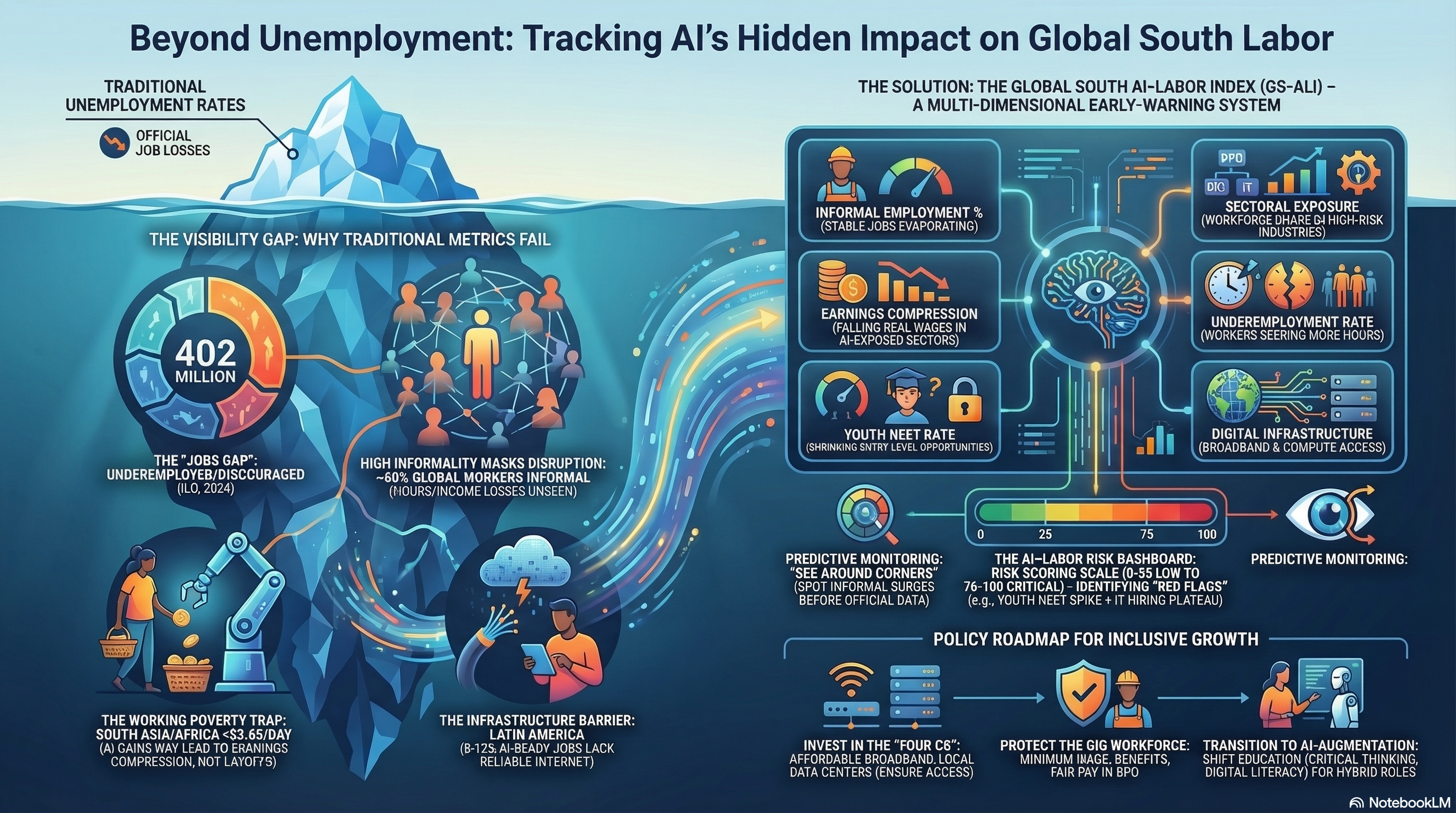
Executive Summary: Traditional AI-employment studies (e.g. Anthropic’s U.S. analysis) focus on automation risk in formal jobs[1][2]. But in developing economies, most work is informal or precarious. The first signs of AI disruption will appear as wage squeezes, underemployment, and informalization of work, not in headline unemployment rates. For example, the ILO estimates a “jobs gap” of 402 million (unemployed+underemployed+discouraged) in 2024[3]. To capture these hidden signals, governments in the Global South need a new monitoring framework – an AI–Labor Index and dashboard – that tracks indicators like informality, income trends, and youth entry into jobs.
This issue brief proposes a Global South AI–Labor Index and accompanying risk dashboard as an early-warning system. Instead of relying solely on unemployment, we recommend tracking six core pillars (see table below): informality, earnings pressure, youth pathways, sectoral exposure, underemployment, and digital readiness. To strengthen policy usefulness, we integrate five additional concerns directly into these six pillars: job quality, AI adoption patterns (augmentation vs substitution), distributional equity, transition capacity, and governance readiness. This keeps the framework practical while making it more decision-relevant for real labor ministries. The bottom line: without these broader but operational metrics, policymakers will miss the first waves of AI impact in their economies, potentially endangering millions of workers.
The Challenge: Hidden Signals of AI-Driven Labor Disruption
Recent research examining the labor market impacts of generative AI provides valuable early insights into how emerging technologies interact with employment structures. For example, an analysis using U.S. labor market data found no systematic increase in unemployment in occupations with high AI exposure [2]. In the context of advanced economies, where labor markets are largely formal and employment transitions are typically recorded through official statistics, focusing on unemployment trends is a reasonable starting point for assessing technological disruption.
However, labor markets across the Global South operate under fundamentally different structural conditions. In many developing economies, employment patterns are shaped by high levels of informality, widespread working poverty, large youth populations entering the labor force, and uneven access to digital infrastructure. Under these conditions, technological disruption is unlikely to appear immediately through rising unemployment. Instead, the early impacts of AI adoption are more likely to surface through subtle but economically significant shifts in earnings, employment stability, and job-entry pathways.
Structural Features of Global South Labor Markets
Several structural characteristics shape how AI-driven disruption may appear across developing economies.
High Informality
According to the International Labour Organization, roughly 60 percent of the global workforce operates in informal employment [4]. Informal workers often combine multiple income sources such as gig work, family enterprises, and casual labor. Because unemployment statistics typically capture only formal labor market participation, they frequently miss these hybrid employment arrangements.
Working Poverty
In many parts of Africa and South Asia, a significant share of workers remain below internationally recognized poverty thresholds despite being employed [3]. In such contexts, productivity gains driven by artificial intelligence may not reduce employment headcounts but may instead compress wages or intensify work conditions.
Youth Underutilization
Young workers entering the labor market are particularly vulnerable to technological disruption. Entry-level roles often involve routine tasks that can be automated or augmented by generative AI tools. In countries such as India, youth unemployment among educated workers remains substantially higher than national averages [5]. Across low-income countries, roughly 28 percent of young people are classified as NEET (not in education, employment, or training) [6]. If AI adoption reduces entry-level hiring, these pressures may intensify.
Digital Divide
AI adoption also depends heavily on digital infrastructure. Reliable internet access, computing capacity, and digital skills determine whether workers and firms can effectively deploy AI technologies. Studies suggest that while a portion of jobs in developing economies could theoretically benefit from generative AI, many operate in environments where reliable connectivity remains limited [7].
Early Signals of AI-Driven Labor Transformation
Taken together, these structural characteristics suggest that unemployment rates alone will significantly understate the labor impacts of AI in developing economies.
Instead, early signals of disruption are more likely to appear through the following dynamics:
-
Earnings Compression
Employment levels remain stable, but real wages decline or working hours become more volatile, particularly in service sectors. -
Informalization of Work
Workers displaced from formal employment shift toward informal or gig-based activities. -
Youth Job-Entry Constraints
Fewer entry-level opportunities emerge for recent graduates, increasing the share of youth in informal employment or NEET status. -
Global Labor Chain Effects
Reductions in outsourcing demand—particularly in sectors such as business process outsourcing—can weaken employment prospects without immediately affecting domestic unemployment statistics.
Without improved monitoring systems, these changes can remain largely invisible to policymakers until labor market stress becomes widespread.
This challenge underscores the need for new measurement tools that track workforce transformation beyond traditional unemployment indicators. The Global South AI–Labor Index and AI–Labor Risk Dashboard are designed to fill this gap by capturing early signals of labor market change across developing economies.
The Global South AI–Labor Index
To translate the conceptual insights of the Global South AI Labor Index (GS-ALI) into a usable policy instrument, the framework must focus on a limited set of core pillars that capture the most meaningful signals of labor market transformation. Rather than constructing an overly complex index with dozens of disconnected indicators, the GS-ALI is designed around six integrated pillars that reflect how technological change typically manifests in developing economies. Each pillar represents a distinct pathway through which artificial intelligence can affect livelihoods, while also incorporating operational sub-indicators that allow policymakers to interpret the underlying dynamics more precisely.
This structure serves two purposes. First, it ensures that the index remains analytically focused and operationally manageable for statistical agencies and policymakers. Second, it allows the framework to capture both labor market outcomes and structural readiness factors, recognizing that technological disruption depends not only on automation potential but also on institutional capacity, workforce mobility, and digital infrastructure.
Informality and job quality
The first pillar focuses on informality and job quality, which are often the earliest indicators of labor market stress in developing economies. In many countries across the Global South, a large share of workers are employed outside formal contractual arrangements, with limited job security and social protection coverage. As a result, technological disruption rarely appears immediately through layoffs. Instead, workers often shift from formal employment into informal or precarious work arrangements.
The core metric within this pillar is the informal employment share, which measures the proportion of workers operating outside formal labor contracts. However, to capture the full extent of job quality deterioration, this metric should be complemented with operational indicators such as the share of temporary or casual contracts, coverage of social protection systems, and the degree of dependence on gig or platform-based income streams. Data for these indicators can be drawn from labor force surveys and international datasets such as the Sustainable Development Goal labor indicators compiled by the International Labour Organization.
Tracking these variables allows policymakers to detect hidden labor market deterioration that might occur before any observable increase in unemployment.
Earnings pressure
The second pillar addresses earnings pressure, which captures shifts in wage dynamics that may arise from AI-driven productivity changes. Even when employment levels remain stable, technological advances can alter the distribution of economic value within sectors. Firms adopting AI tools may increase productivity while simultaneously reducing the number of workers required to perform certain tasks, thereby placing downward pressure on wages.
The core metric for this pillar is the trend in real wages or earnings within AI-exposed sectors. Supporting indicators include the wage–productivity gap, volatility in working hours, and changes in pay-per-task compensation models commonly observed in platform-based work arrangements. These indicators can be constructed using household income surveys, wage statistics, and sector-specific employment data.
Monitoring earnings dynamics is particularly important because income compression often precedes visible employment shocks, especially in service sectors where AI can augment or partially replace routine tasks.
Youth pathways and transition capacity
A third pillar focuses on youth employment pathways and workforce transition capacity. Young workers entering the labor market are often disproportionately exposed to technological disruption because entry-level roles typically involve routine tasks that are easier to automate.
The primary indicator in this pillar is the rate of youth not in employment, education, or training (NEET) combined with trends in graduate job placement. These measures provide insight into how easily young workers are able to transition from education into stable employment. Additional operational indicators include the average time required to secure a first job, apprenticeship absorption rates, and the ratio of training completion to post-training job placement.
These indicators can be derived from education and labor datasets maintained by institutions such as the United Nations Educational, Scientific and Cultural Organization and the International Labour Organization. Persistent deterioration in youth employment indicators may signal long-term risks of labor market scarring, where an entire generation experiences reduced career mobility due to technological shifts.
Sectoral AI exposure and adoption
The fourth pillar examines sectoral exposure to artificial intelligence and the rate of AI adoption within industries. Traditional automation studies typically estimate the theoretical susceptibility of occupations to AI-enabled task substitution. However, actual labor market impact depends on whether firms adopt these technologies at scale.
The core metric in this pillar is the share of national employment concentrated in sectors vulnerable to AI-enabled automation, such as information services, customer support, financial analysis, and digital marketing. Operational indicators can include the rate of AI tool adoption among firms, the balance between task augmentation and task substitution, and volatility in outsourcing contracts within global service industries.
Relevant data sources include national accounts, firm-level surveys, and employment statistics in sectors such as business process outsourcing and information technology services. Tracking these indicators allows policymakers to distinguish between theoretical technological capability and real economic disruption.
Underemployment stress
The fifth pillar addresses underemployment, a critical but often overlooked signal of labor market distress. In many developing economies, workers experiencing technological displacement may remain technically employed but experience reduced working hours or diminished utilization of their skills.
The core metric for this pillar is the underemployment rate, defined as the share of workers who are employed but seeking additional working hours or working in roles that underutilize their qualifications. Supporting indicators include the prevalence of involuntary part-time work, dependence on multiple income sources, and reductions in average working hours within vulnerable sectors.
These measures are typically captured through labor force surveys using definitions aligned with those of the International Labour Organization. Because underemployment often increases before unemployment during economic transitions, this pillar can function as an early cyclical distress indicator.
Digital and governance readiness
The final pillar evaluates digital and governance readiness, which determines how rapidly AI technologies can be deployed and how effectively labor institutions can respond to their impacts. The adoption of artificial intelligence depends heavily on digital infrastructure, access to computing resources, and the availability of workforce skills. At the same time, institutional readiness—including labor regulations and oversight mechanisms—plays an important role in shaping how AI is implemented in workplaces.
The primary metric in this pillar is a connectivity and compute readiness score, reflecting the availability of reliable internet access, enterprise AI infrastructure, and digital data resources. Complementary indicators include enterprise access to AI technologies, the capacity of labor inspection agencies, and the presence of grievance mechanisms for workers affected by algorithmic management.
Data for these indicators can be drawn from global digital infrastructure datasets maintained by institutions such as the International Telecommunication Union and the World Bank, alongside national labor administration statistics.
Together, these six pillars provide a structured framework for monitoring how artificial intelligence interacts with labor markets in developing economies. Rather than focusing solely on unemployment or theoretical automation risk, the Global South AI–Labor Index captures the full spectrum of workforce transformation, including shifts in job quality, earnings dynamics, youth employment pathways, sectoral disruption, and institutional readiness.
By integrating these dimensions into a single monitoring framework, the GS-ALI enables governments to detect early signals of labor market stress and design policies that ensure technological progress translates into inclusive economic development rather than widening inequality.
Operationalizing the Global South AI Labor Index
For the Global South AI Labor Index (GS-ALI) to serve as a credible monitoring tool rather than a theoretical construct, its operational design must emphasize transparency, consistency, and policy usability. The index is intended to function as a recurring statistical instrument—similar in spirit to economic stress indices or financial stability dashboards—allowing governments and regulators to detect early signals of AI-driven labor market transformation. Implementing the index therefore requires a structured process that combines regular data collection, standardized scoring, transparent aggregation methods, and disciplined publication protocols.
Data collection and update cadence.
The first operational step involves establishing a reliable pipeline of labor market data. Inputs to the index should be drawn from multiple sources to ensure that both formal and informal labor dynamics are captured. These include national labor force surveys, administrative payroll and tax records, targeted firm pulse surveys on technology adoption, and data-sharing arrangements with industry associations or digital labor platforms. In economies where official labor statistics are published with a delay, complementary sources such as enterprise surveys and platform labor datasets can provide more timely insights into workforce changes. The index should ideally be updated on a monthly or quarterly cadence, allowing policymakers to track emerging trends in near real time. At the same time, each year the index should be reconciled with official statistical releases from national statistical agencies to ensure methodological consistency and long-term comparability.
Normalization and stress scoring.
Because the index aggregates diverse indicators—ranging from informality rates to youth employment outcomes—each metric must first be standardized to allow comparison. This is achieved by converting raw indicators into a 0–100 stress score relative to a defined national baseline. The baseline could be established using a three-year historical average prior to the widespread adoption of generative AI or prior to the introduction of major technology policy changes. Indicators that represent deteriorating labor conditions, such as rising youth unemployment or increasing NEET rates, are scored so that higher values correspond to greater labor market stress. Conversely, indicators that reflect resilience—such as higher retraining placement rates or stronger wage growth—are reverse-coded so that improvements reduce the stress score. This normalization ensures that the index consistently reflects labor vulnerability rather than raw statistical variation.
Pillar-level scoring.
Once individual indicators are standardized, they are aggregated into thematic pillars representing different dimensions of workforce transformation. Each pillar—such as informality dynamics, earnings compression, youth employment pathways, sectoral AI exposure, underemployment, and digital infrastructure readiness—contains multiple sub-indicators. At the initial stage of implementation, a practical and transparent approach is to apply equal weighting across sub-indicators within each pillar. Equal weighting reduces methodological complexity and prevents subjective bias during the early stages of index development. After one year of operational use, the weighting structure can be refined using back-testing and statistical validation to determine which indicators most strongly predict labor market stress.
Composite index calculation.
The overall GS-ALI score is then calculated as the weighted average of the pillar scores. During the initial phase, equal weighting across the six pillars provides a balanced representation of labor market conditions. However, the index should not be interpreted solely at the national level. One of the most important analytical functions of the framework is to reveal localized or sector-specific disruptions that may be masked by national averages. Accordingly, the dashboard accompanying the index should publish subnational breakdowns by region as well as sectoral slices highlighting industries with high exposure to AI-driven task automation. These granular views allow policymakers to identify concentrated shocks—for example, disruptions within business process outsourcing hubs or digital services clusters—that might otherwise remain hidden.
Confidence and data quality assessment.
A critical feature of the GS-ALI methodology is the inclusion of a confidence grading system for each pillar score. Not all labor market data sources are equally reliable or timely, particularly in developing economies where statistical capacity may be uneven. To address this challenge, each pillar should be assigned a data-quality flag—classified as high, medium, or low confidence—based on criteria such as sample coverage, reporting timeliness, and historical consistency. This grading system ensures that policymakers interpret the index cautiously and do not overreact to signals derived from incomplete or volatile datasets. By explicitly communicating data quality, the index promotes responsible use of evidence in policy decision-making.
Publication and transparency protocols.
Finally, the credibility of the GS-ALI depends on a disciplined publication process. The index should be disseminated through quarterly dashboard bulletins summarizing key trends, risk signals, and sectoral developments. These briefings allow policymakers and researchers to track evolving labor market conditions in near real time. In addition, an annual methodology report should be released documenting any revisions to indicator definitions, weighting schemes, baseline assumptions, or threshold values. Publishing methodological updates ensures transparency and allows the research community to scrutinize and improve the framework over time.
Taken together, these operational steps transform the Global South AI Labor Index from a conceptual framework into a practical monitoring instrument. By combining regular data collection, standardized scoring, transparent aggregation, and rigorous publication practices, the index can provide governments with an early-warning system for understanding how artificial intelligence is reshaping labor markets across developing economies.
AI–Labor Risk Dashboard
While the Global South AI–Labor Index provides a structured framework for measuring workforce transformation, policymakers also require a practical mechanism for interpreting the data in real time. For this purpose, the index can be operationalized through an AI–Labor Risk Dashboard—a visual monitoring tool designed to track key indicators, identify emerging labor market stresses, and support timely policy intervention.
The dashboard would display each index pillar and its underlying indicators as time-series trends, allowing policymakers to observe how labor market conditions evolve as artificial intelligence adoption spreads across sectors. Rather than presenting raw statistics alone, the system would highlight early warning signals, flagging sudden changes that may indicate AI-driven workforce disruption.
For example, a rapid increase in the share of informal employment within a specific service sector, combined with a decline in real wages, may suggest that firms are restructuring work arrangements in response to productivity gains from AI tools. Similarly, a rise in the youth NEET rate coinciding with stagnation or contraction in hiring within IT services or business process outsourcing sectors could indicate weakening entry pathways for young workers entering the labor market. Another potential signal may emerge through a growing share of working poverty among formally employed workers, suggesting that technological change is compressing wages or reducing working hours even where employment levels remain stable.
By visualizing these trends together, the dashboard enables policymakers to detect patterns that may not be visible through isolated statistics. In effect, the system functions as an early warning instrument, allowing governments to respond before localized disruptions develop into broader labor market crises.
To facilitate interpretation, the dashboard can aggregate indicator scores into an overall AI labor risk level for the country or for individual regions. A simple scoring framework can be used to classify risk levels along a four-tier scale: scores between 0 and 25 would indicate low labor market risk; 26 to 50 would signal moderate stress; 51 to 75 would reflect high risk of workforce disruption; and 76 to 100 would represent critical conditions requiring urgent policy attention. These thresholds should be periodically reviewed as the index matures and more empirical data becomes available.
The practical value of the AI–Labor Risk Dashboard lies in its ability to support targeted policy responses. If the dashboard identifies rising stress within a particular industry, governments can prioritize reskilling programs and workforce transition support for affected occupations. If risk indicators concentrate geographically, social protection mechanisms and regional economic development initiatives can be deployed to stabilize local labor markets. In this way, the dashboard transforms the Global South AI–Labor Index from a measurement framework into a policy decision-support tool, enabling governments to manage the workforce implications of artificial intelligence more proactively.
Ultimately, the objective of the dashboard is not merely to observe technological change, but to ensure that policymakers have the evidence needed to guide inclusive economic adaptation as artificial intelligence reshapes the future of work across developing economies.
Policy Recommendations
The Global South AI–Labor Index and the accompanying AI–Labor Risk Dashboard are intended not only as analytical tools but also as instruments to inform proactive policymaking. As artificial intelligence reshapes production processes and service delivery across sectors, governments in developing economies must ensure that labor market monitoring systems and policy responses evolve accordingly. The following recommendations outline priority actions that can help policymakers anticipate workforce disruption and guide inclusive technological adoption.
Strengthen labor market statistics.
A critical first step is to expand national labor statistics systems so they capture the full range of employment dynamics present in developing economies. Traditional labor surveys often focus on formal employment and unemployment rates, overlooking key dimensions such as informality, underemployment, and multi-job income strategies. Statistical agencies should therefore broaden survey instruments to measure these phenomena systematically. In addition, targeted questions should be incorporated into firm and worker surveys to track the use of AI tools in workplaces, including whether such tools augment tasks or substitute for human labor. Governments can also explore partnerships with digital platforms and technology firms to obtain anonymized and aggregated data on AI usage patterns. By improving the granularity of labor statistics, policymakers will be better positioned to detect the early workforce impacts of AI adoption.
Establish an AI–Labor Observatory for early warning monitoring.
Beyond improving data collection, governments should institutionalize a dedicated monitoring mechanism for AI-driven workforce transformation. One approach would be to establish a national AI–Labor Observatory responsible for maintaining the Global South AI–Labor Index and publishing regular risk assessments. This observatory could operate within a ministry of labor, a national statistical office, or a specialized research unit. Quarterly bulletins based on the AI–Labor Risk Dashboard would provide policymakers with a structured overview of emerging trends in employment conditions, sectoral hiring patterns, and workforce transitions. By institutionalizing such monitoring systems, governments can move from reactive responses to preemptive policy interventions, such as launching reskilling programs before large-scale layoffs or wage compression occur.
Invest in digital infrastructure and AI readiness.
The capacity of workers and firms to benefit from artificial intelligence depends heavily on digital infrastructure and access to technological resources. The World Bank has emphasized four foundational components of digital readiness—connectivity, computing capacity, data availability, and workforce skills. Many countries across the Global South face gaps across one or more of these dimensions. Public investment in reliable broadband networks, affordable mobile connectivity, and domestic data infrastructure can help reduce barriers to AI adoption while enabling local innovation ecosystems to emerge. Equally important is the development of AI tools and digital services in local languages, ensuring that workers across diverse linguistic contexts can participate in the digital economy.
Strengthen protections for vulnerable workers.
Technological transitions often place disproportionate pressure on workers employed in precarious or informal arrangements. Governments should therefore extend basic labor protections—such as minimum wage standards, social protection coverage, and workplace safety regulations—to gig workers and other forms of non-traditional employment. In sectors heavily affected by AI-enabled productivity gains, such as customer service outsourcing or content moderation, policy frameworks should ensure that increased efficiency translates into fair compensation rather than intensified workloads. For instance, if AI tools enable call center agents to process more interactions per hour, compensation structures should reflect the higher productivity rather than simply raising performance quotas. Ensuring equitable distribution of technological gains is essential for maintaining social stability during periods of rapid innovation.
Promote training for AI-augmented work.
Education and workforce development systems must also adapt to the changing nature of work in an AI-enabled economy. Rather than focusing exclusively on technical specialization, training programs should emphasize skills that complement AI technologies, including digital literacy, analytical reasoning, and human oversight of automated systems. Universities, vocational institutions, and professional training centers should incorporate AI tools into teaching environments so students gain familiarity with hybrid work models in which humans and intelligent systems collaborate. Preparing the workforce for AI augmentation rather than displacement will help ensure that technological progress expands productivity while sustaining employment opportunities.
Strengthen international cooperation on AI labor metrics.
Finally, international cooperation will be essential for developing a shared evidence base on the labor implications of artificial intelligence. Multilateral organizations such as the International Labour Organization and the United Nations Educational, Scientific and Cultural Organization can play an important role in promoting standardized methodologies for tracking AI’s workforce impacts. Donor agencies and research institutions could support pilot implementations of the Global South AI–Labor Index across representative countries, enabling refinement of the methodology and comparative analysis across regions. In parallel, technology companies should be encouraged to share anonymized usage data that can contribute to independent public research on AI adoption and labor market outcomes.
Conclusion
Recent research from technology firms and academic institutions provides valuable insights into how artificial intelligence may reshape labor markets in advanced economies. However, these analyses often assume labor market structures that differ significantly from those found across much of the Global South. In many developing economies, workforce disruption is more likely to appear through rising informality, declining earnings stability, and weakening entry pathways for young workers rather than through immediate increases in unemployment.
Without new measurement frameworks, these shifts may remain invisible in conventional statistics until their consequences become severe. The Global South AI–Labor Index and AI–Labor Risk Dashboard offer a practical approach to addressing this challenge by providing policymakers with tools to detect early signals of workforce transformation. By monitoring trends in job quality, earnings dynamics, youth employment, sectoral exposure, and digital readiness, governments can identify emerging risks and design targeted policy responses.
The stakes are significant. Artificial intelligence has the potential to enhance productivity and support economic development across the Global South. Yet without appropriate monitoring systems and policy safeguards, technological change could also deepen existing inequalities and undermine labor market stability. The challenge for policymakers is therefore not simply to observe the transformation of work, but to shape it—ensuring that AI becomes a driver of inclusive growth rather than a catalyst for hidden economic distress.
Table: Proposed Global South AI–Labor Index Metrics (illustrative)[4][6]
| Indicator | Data Source / Rationale |
|---|---|
| Informal employment share (%) | ILO SDG data[4] – % of workforce informal. |
| Earnings pressure (real wages) | National surveys (ILO/World Bank) – trends in wages in exposed jobs. |
| Youth NEET rate (%) | ILO/UNESCO – % of 15–24 not in education/employment[6]. |
| Sectoral exposure (BPO, IT) | Labor force surveys – % in high-exposure industries (from O*NET). |
| Underemployment rate (%) | ILO – % of employed wanting more hours (ICLS definition). |
| Digital access (connectivity) | ITU/World Bank – % with internet/smartphone[8]. |
References
[1] Anthropic Economic Index: https://www.anthropic.com/economic-index
[2] Anthropic, Labor Market Impacts of AI: https://www.anthropic.com/research/labor-market-impacts
[3] ILO, World Employment and Social Outlook: Trends 2024: https://www.ilo.org/publications/world-employment-and-social-outlook-trends-2024
[4] World Economic Forum, Global informal economy explained: https://www.weforum.org/agenda/2024/01/global-informal-economy-explained/
[5] ILO India country/statistical resources (youth labour indicators): https://www.ilo.org/country/india
[6] ILOSTAT data portal (incl. youth NEET indicators): https://www.ilo.org/ilostat
[7] ILO publications (including Global South/Latin America AI labour studies): https://www.ilo.org/publications
[8] World Bank Digital Development (including the “four Cs” framing): https://blogs.worldbank.org/digital-development
[9] Rest of World reporting on AI and BPO/call-center workflows: https://restofworld.org/
Related in this cluster
📥 AI in Workforce Series: The Global South AI Labor Index and Risk Dashboard - A Framework for Monitoring AI’s Workforce Impact (PDF)
👉 Download the Case Study Deck (PDF)
Stay tuned — new posts every week!
💬 Join the Conversation
Have thoughts, experiences, or questions about AI fairness? Share your comments, discuss with global experts, and connect with the community:
👉 Reach out via the Contact page
📧 Write to us: support@globalsouth.ai
🌍 Follow GlobalSouth.AI
Stay connected and join the conversation on AI governance, fairness, safety, and sustainability.
- LinkedIn: https://linkedin.com/company/globalsouthai
- Substack Newsletter: https://newsletter.globalsouth.ai/
Subscribe to stay updated on new case studies, frameworks, and Global South perspectives on responsible AI.
Related Posts

AI and the Global South Workforce: The Next 10 Years
A Strategic Outlook for Labor, Development, and Artificial Intelligence

The Silent AI Shock in Workforce: An India Case Study
Why unemployment statistics will miss the real disruption of AI in the workforce in the Global South

What Anthropic’s AI Jobs Study Misses in the Global South
Anthropic’s recent study on AI and jobs offers valuable insights into how artificial intelligence may affect labor markets in advanced economies. But the same framework does not fully capture how workforce disruption unfolds in the Global South—where informality, youth employment pressures, and service outsourcing shape labor market realities.